Inside Myanmar's Jungle Scam Factories: How a Global Crime Industry Evades Every Crackdown
Armed fighters discovered roughly 3,000 captive workers inside a scam compound hidden behind razor wire in Myanmar's jungle. Investigators say the industry isn't shrinking. It's moving deeper into the forest.
Key points
- The Karen National Liberation Army freed roughly 3,000 captive workers from a compound called Shunda Park in Myanmar's border region in 2025.
- The United Nations Office on Drugs and Crime estimates at least 120,000 people are trapped inside scam compounds across Myanmar.
- Workers described being hung by chains and locked in dark rooms with little food or water as punishment for missing scam quotas.
- Investigators say the industry isn't disappearing but moving deeper into Myanmar's jungle, further from the Thai border, where oversight is almost nonexistent.
- Satellite imagery shows new compounds under construction even as authorities announced crackdowns on larger, well-known sites.
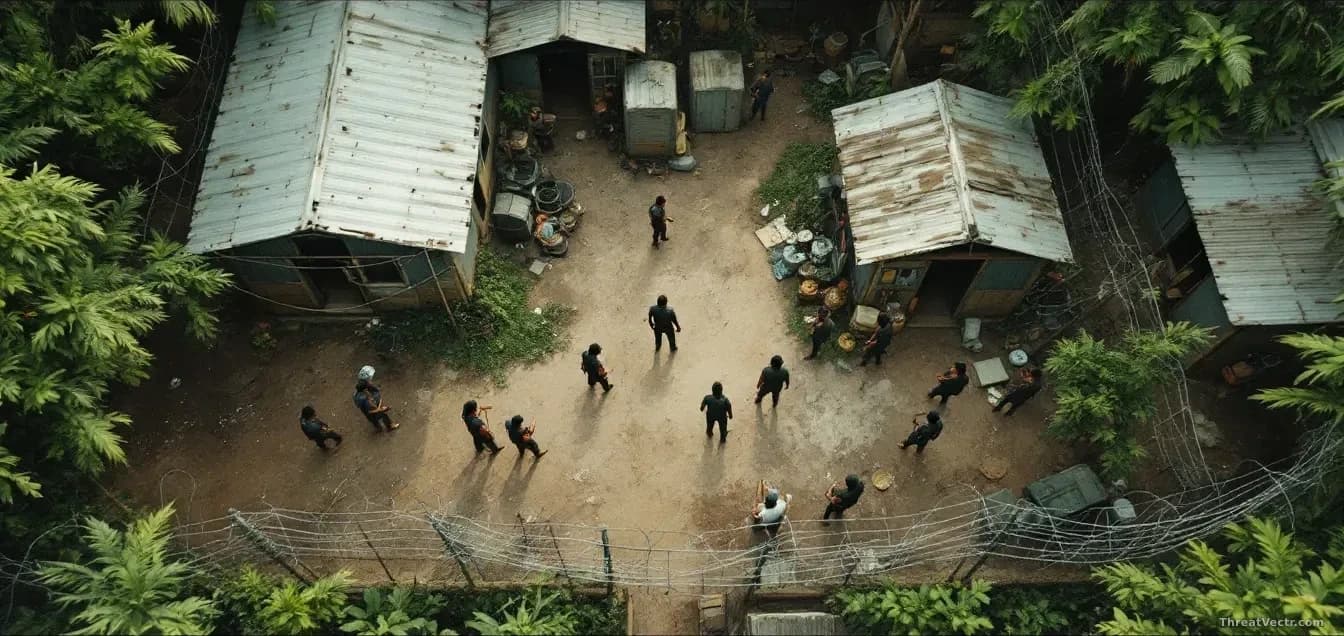
Pro-democracy fighters in Myanmar walked into a jungle compound and found something closer to a prison than an office. Behind razor wire and dense tree cover sat Shunda Park, one of the country's biggest scam operations, where approximately 3,000 people had been forced to defraud strangers online for the benefit of criminal bosses.
The Karen National Liberation Army, an ethnic armed group fighting Myanmar's military, made the discovery after retaking that territory. Documentation of what was inside came from the Free Burma Rangers, a humanitarian organisation that provided medical care to survivors.
What actually happens inside these compounds?
People are trafficked there: lured or kidnapped across borders and held against their will. Ivan, a Malaysian man freed from Shunda Park, told ABC News Australia he was brought through Thailand under false pretences. Once inside, workers were ordered to run "pig butchering" scams, a fraud method where criminals build fake romantic relationships online over weeks or months before persuading victims to hand over large sums, usually through cryptocurrency.
Fail to hit your quota and the punishment was severe. Ivan described being suspended by chains and kept in dark rooms. Guards reportedly carried rubber-coated batons designed to cause intense pain without leaving visible marks. Lin, a Taiwanese man held in a separate compound, told aid organisations he was caged and handcuffed in direct sunlight after he tried to contact police, and could hear his ribs grinding when he breathed.
Workers who generated enough money were housed on upper floors with better conditions. Everyone else went into isolation. Wi-fi stayed on. The only way out was to keep scamming.
Troops who entered Shunda Park recovered thousands of phones and hard drives, alongside training manuals walking workers through romance scams targeting people in the United States and Australia.
If someone online has become quickly romantic and is now asking you to invest through an unfamiliar platform, that's the shape of this fraud. Stop contact, tell your bank, then report it to your national consumer protection authority.
Should you worry about crackdowns working?
They aren't working. Crackdowns on large, well-publicised sites such as KK Park, which once held up to 25,000 people, haven't stopped the industry. Anti-trafficking investigators say demolitions were in many cases staged, with buildings near main roads made to look damaged while operations shifted elsewhere. One investigator told ABC News Australia that KK Park remains standing and operational.
We first covered the spread of these compound-based fraud operations on 18 July 2026, when Timor-Leste police arrested 314 people in raids just 700 kilometres from Darwin.
Satellite analysis by the Australian Strategic Policy Institute shows new, smaller compounds appearing in 2024, particularly along the Moei River in southern Myanmar, far from border crossings where international observers might notice. These sites hold fewer workers and, according to analysts, use more violence precisely because they can't recruit freely from nearby towns.
"Scam centres require only a small footprint: a rented hotel, computers, electricity and permissive local law enforcement," one analyst told the outlet. That combination makes the industry extraordinarily hard to shut down across the region.
The real story here isn't the raid on Shunda Park. It's that every publicised crackdown has, so far, just redrawn the map.