Fortinet unveils FortiGate 1200G firewall with built-in SASE enforcement for on-premises sites
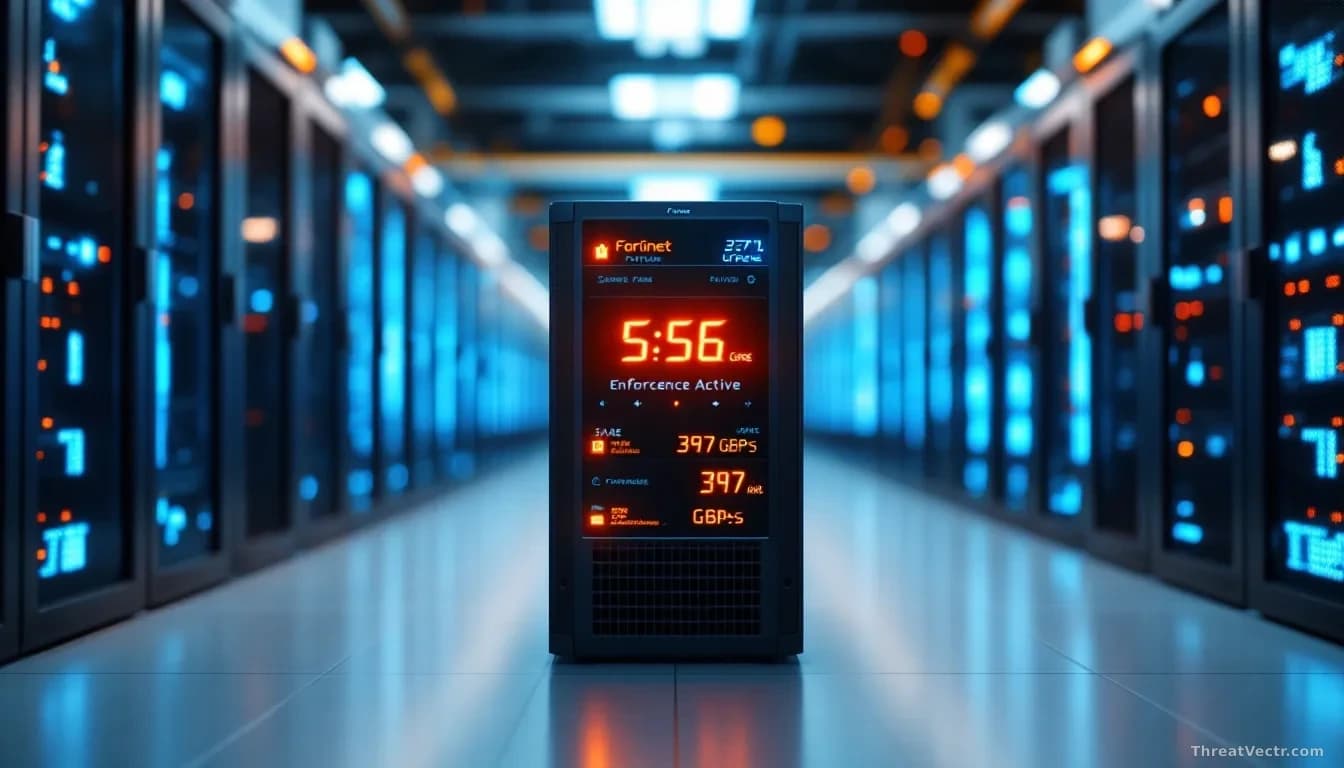
The new midrange appliance pushes cloud-style security policy into company-controlled buildings and data centres, running at up to 397 Gbps. Availability is set for Q3 2026.
Key points
- Fortinet's FortiGate 1200G delivers up to 397 Gbps firewall throughput and supports 10G, 25G, 100G network connections.
- The hardware runs FortiOS 8.0 and enables FortiSASE Outpost, which lets organisations enforce cloud security policies inside their own buildings instead of routing traffic through a remote cloud service.
- The 1200G sits between Fortinet's smaller branch-office appliances and its large data centre hardware, aimed at campus and hybrid environments.
- It competes against enterprise firewalls from Cisco, Palo Alto Networks, Check Point, and HPE/Juniper.
- General availability is expected in Q3 2026, as first reported by CSO Online.
What is this product and why does it exist?
Fortinet has announced a new firewall appliance aimed at large offices and private data centres that need to inspect enormous volumes of network traffic without slowing everything down. It slots into the middle of Fortinet's product range, above branch-office boxes like the 400G and below flagship data centre machines like the 3500G.
At 397 Gbps of firewall throughput, this is hardware built for volumes found only in large corporate or institutional environments.
| Specification | Detail |
|---|---|
| Model | FortiGate 1200G series |
| Max firewall throughput | 397 Gbps |
| Supported port speeds | 10G, 25G, 100G |
| Operating system | FortiOS 8.0 |
| Key new feature | FortiSASE Outpost |
| Availability | Q3 2026 |
What is SASE, and why does running it on-site matter?
SASE, pronounced "sassy" and short for Secure Access Service Edge, is a model where security checks happen in a vendor's cloud rather than on hardware inside a company's own building. Traffic leaves the site, gets inspected remotely, then comes back. It's convenient, but it adds latency and can conflict with regulations that require certain data to stay within private or geographic boundaries.
FortiSASE Outpost changes that. When the 1200G is configured as an Outpost, it acts as a local enforcement point: security checks happen physically on-site while policy is still managed through Fortinet's central cloud dashboard. Designated traffic, logs, and processing can stay within defined infrastructure boundaries, Fortinet says, without changing the end-user experience. For regulated industries where data sovereignty is a hard requirement, that's a meaningful difference from a standard cloud-only SASE deployment.
Our 15 July story on why old traffic inspection is falling behind shows exactly the gap this architecture is meant to close.
Should IT teams take note of the FortiOS 8.0 update?
Yes. FortiOS 8.0 ships with AI-assisted management tools and tighter integration across Fortinet's product ecosystem, alongside FortiSASE Outpost. Teams already running older Fortinet hardware should check whether 8.0 applies to their existing devices and review the release notes before upgrading, because major OS versions can introduce configuration changes.
One thing worth keeping in mind: Fortinet hardware has attracted attacker attention this year. CISA flagged actively exploited Fortinet flaws in July, a reminder that a high-throughput appliance is only as safe as its patch cadence. The 1200G won't reach customers until Q3 2026, which gives security teams time to plan, but also gives researchers time to look hard at FortiOS 8.0.