AI Smart Glasses Are Walking Into Your Office. Nobody Knows How to Stop Them.
Samsung's entry into AI-powered glasses has forced security leaders to face an uncomfortable truth: the recording device problem is already everywhere, and a ban probably makes things worse.
Key points
- Samsung has joined Apple, Google, and Meta in selling AI-powered glasses capable of continuous audio and video recording.
- Security experts say a blanket workplace ban is nearly unenforceable and could expose employers to disability discrimination lawsuits.
- Smart glasses such as Meta's Ray-Bans are visually identical to ordinary prescription frames, making detection in offices and on home video calls close to impossible.
- Analysts recommend a tiered approach: strict no-wearables rules in boardrooms and research labs, disclosure requirements in general meetings.
- The greatest risk is not intentional spying but accidental capture of sensitive information during ordinary workplace moments.
Samsung's arrival in the AI glasses market, joining Meta, Google, and Apple, sounds like a consumer technology story. For the people responsible for keeping company data safe, it is an operational headache with no clean answer.
The problem is simple to describe and hard to fix. These glasses can record video and audio continuously. They look like ordinary eyewear. And most of the people wearing them into your office are not spies. They are just employees.
How does a pair of glasses become a security problem?
The glasses capture and transmit data, often to cloud servers operated by the manufacturer, meaning recordings do not stay on the device. A cloud server is a computer owned by another company and accessed over the internet.
The concerning scenario is not the deliberate leak. Gartner senior principal analyst Meghan Hollis described a realistic example to CSO Online: an employee records a permitted meeting, forgets to stop recording on the walk back to their desk, and a passing executive casually mentions a confidential acquisition. That conversation is now in the cloud, and nobody noticed it happen.
Hollis also flagged data sovereignty, meaning questions about which country's laws cover the data. A glasses manufacturer might promise to store recordings only in specific countries, then quietly change that policy or swap to a different third-party storage vendor. That could violate export control rules without anyone intending it.
Can IT departments just ban them?
In practice, no. Not cleanly.
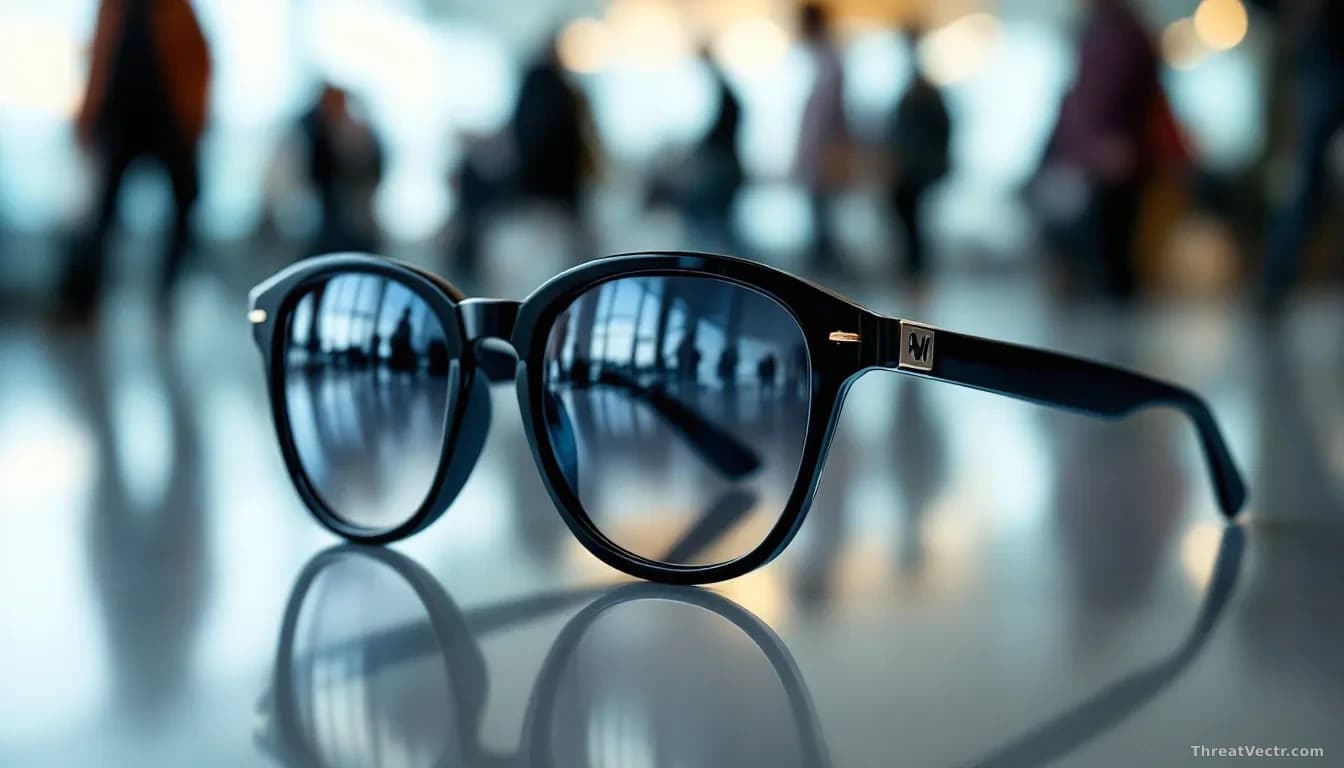
Meta's Ray-Ban smart glasses are the clearest example of the problem. They are designed to be indistinguishable from a regular pair of Ray-Bans. There is no badge, no obvious camera housing, no blinking light visible from across a room.
IDC director Jitesh Ubrani put it plainly: enforcing a ban in a hybrid or work-from-home setting is close to impossible. An IT team scanning for Bluetooth signals (short-range wireless signals devices use to communicate) tied to known glasses manufacturers can only catch devices that are actively broadcasting and have not been reconfigured. A home video call offers no detection options at all.
Attempting a total ban also carries legal risk. Walt Disney World faced a lawsuit after telling an employee she could not use Meta glasses. An employee who relies on smart glasses as assistive technology for a vision impairment has grounds to challenge an outright prohibition.
| Environment | Suggested policy |
|---|---|
| Boardrooms and executive meetings | Strict no-wearables rule, enforced like existing phone bans |
| Research labs and R&D spaces | No wearables, physical check at entry |
| General open office | Disclosure required if a recording-capable device is worn |
| Home or hybrid calls | Policy statement plus education; enforcement not technically feasible |
| Accessibility exceptions | Narrow exemption with mandatory disclosure to colleagues |
What should companies actually do?
The analysts quoted in the original reporting broadly agree: stop trying to write one rule for every situation.
Ubrani recommends a tiered policy. Boardrooms, research labs, and anywhere trade secrets or regulated data get discussed deserve strict no-wearables enforcement. General office floors probably do not need the same level of restriction, but meetings should require disclosure whenever a recording-capable device is present.
Hollis argues that punishment should be the last resort, not the first move. Educating employees about specific harms, telling them clearly what recording a hallway conversation could cost the company and its customers, is more likely to change behaviour than a policy nobody can enforce.
Brian Jackson of Info-Tech Research Group takes the harder line: start with a restrictive acceptable use policy now, before the devices become as embedded as smartphones. But even he acknowledges an outright ban goes too far.
The failure mode here is waiting for an incident before writing the policy. By then, the data is already in someone else's cloud.
Write the tiered policy before the glasses write themselves into your next postmortem.