US agencies warn hackers are using AI to break into Siemens factory controllers
CISA, NSA, FBI, DOE and EPA say attackers are scanning the internet for exposed Siemens S7 PLCs and running AI-written scripts dressed up as monitoring tools.
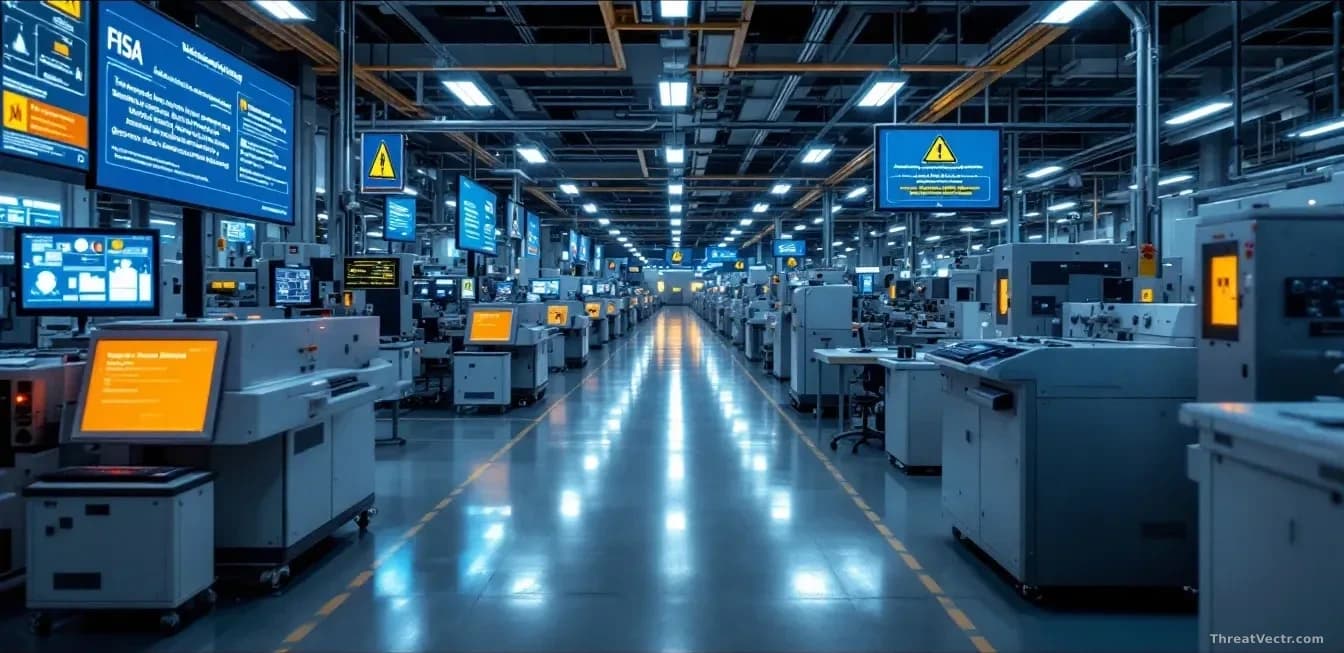
Key points
- Five US agencies, led by CISA, warned of active targeting of Siemens S7 Series programmable logic controllers used across manufacturing, energy, water, chemicals, food, and commercial facilities.
- Attackers are using AI to write Python scripts that mimic legitimate monitoring software and talk to controllers over the S7comm protocol.
- All S7 model families are in scope: S7-200, S7-300, S7-400, S7-1200, and S7-1500, including F-series safety controllers.
- The hackers find targets through public internet-scanning services such as Censys and ZoomEye, then log in using default or weak passwords.
- Agencies assess the activity as reconnaissance and pre-positioning: the groundwork for future attacks that could disrupt physical processes.
Five US federal agencies have issued a joint warning that hackers are actively going after Siemens factory-floor computers, and they're using artificial intelligence to speed up the work.
The advisory comes from the NSA, the Cybersecurity and Infrastructure Security Agency (CISA), the FBI, the Department of Energy, and the Environmental Protection Agency. It focuses on Siemens S7 Series programmable logic controllers, or PLCs, the small industrial computers that open valves, keep motors running, and hold production lines in check inside factories, power plants, and water utilities.
This isn't a drill. Attackers are already in the reconnaissance phase, mapping US installations and probing what they can reach.
Which devices are being targeted?
Every current Siemens S7 family is on the list. That covers older S7-200 and S7-400 units still running in long-life plants, the widely deployed S7-300 line, plus the newer S7-1200 and S7-1500 series, including the F-series safety controllers that trigger emergency shutdowns.
| Model family | CPU variants in scope |
|---|---|
| S7-200 | All |
| S7-300 | All, including 314, 315, 317 |
| S7-400 | All |
| S7-1200 | 1211C, 1212C, 1214C, 1215C, 1217C |
| S7-1500 | All, including F-series safety CPUs |
The sectors most in the crosshairs are critical manufacturing, energy, water and wastewater, chemicals, food and agriculture, and commercial facilities. Siemens PLCs also sit inside defence industrial base plants, which the agencies say could be hit next.
How are the hackers getting in?
They're looking for controllers plugged straight into the public internet. Once found, they log in with default or barely-changed passwords, then run scripts that speak the controller's native language.
To find targets, the attackers use commercial internet-scanning services like Censys and ZoomEye, which index every device visible online. That gives them a shopping list of exposed PLCs running outdated firmware.
What's notable about the scripts is what they're built to look like. CISA describes AI-generated Python code built around snap7 and python-snap7, open-source libraries that talk to Siemens controllers over the S7comm protocol, the standard way S7 devices exchange data. Wrapped up, the tools resemble ordinary factory monitoring software, which is what lets them slip past security teams.
With that access, attackers can read and write to the PLC's memory, its configuration, and its ladder logic, the program that tells the machine what to do. Our 4 August report on the Minnesota water attacks found a related wrinkle: in some cases hackers may walk out with the only complete copy of control logic the operators ever had.
Should operators actually worry?
Yes. Read access seen so far looks like homework for future write operations: the attackers are learning the plant so they can later change how it runs.
The potential consequences in the advisory are blunt: disrupted production, safety incidents if emergency shutdowns are tampered with, physical damage to equipment run outside safe limits, stolen process recipes, and knock-on effects across connected suppliers.
Using AI to write the exploit code collapses the skills gap. Attacking industrial kit used to demand years of specialist knowledge. A large language model can now produce a working script from public vulnerability writeups in minutes.
What should operators do now?
CISA's top actions are practical. Inventory every S7 PLC, apply Siemens' security patches, and get the devices off the public internet. Tighten authentication, replace default credentials, and watch for unusual S7comm traffic or unexpected writes to data blocks.
Pay particular attention to third-party integrators and service providers with remote access. Asset owners often don't realise a contractor has punched a hole through the firewall for convenience.
The advisory notes the threat is broader than Siemens gear alone. Every PLC owner should treat its mitigations as a checklist, not a brand-specific problem.