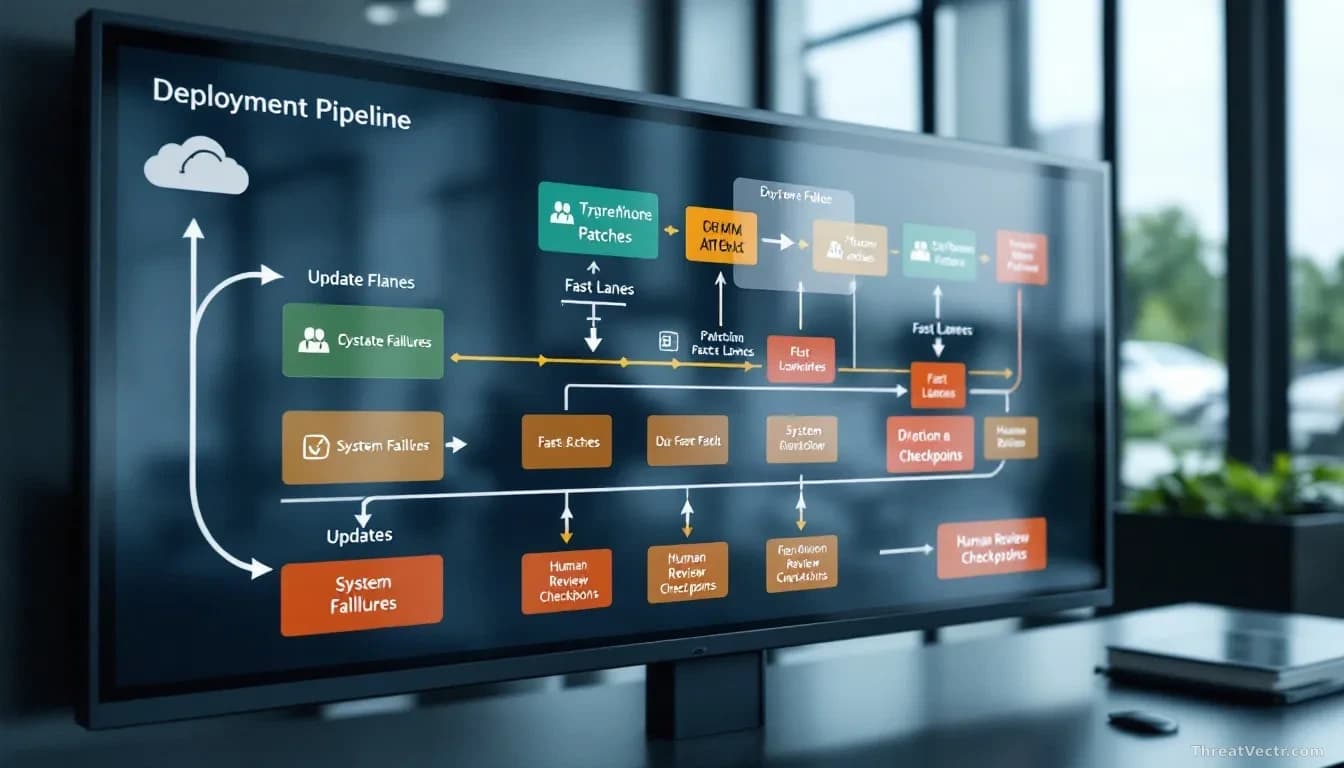
The Patch Cycle Won't Survive Machine-Speed Adversaries
Defenders measured dwell time in days. Agentic attack pipelines are about to measure it in minutes.

Key points
- LLM-driven pipelines can ingest a vendor advisory and emit a candidate exploit the same afternoon it publishes.
- The window between disclosure and in-the-wild exploitation is compressing to hours, not days.
- CVSS-based prioritization becomes nearly useless when exploit development is no longer the rate-limiting step.
- Compensating controls, not patch cadence, are the primary mitigation in this environment.
- Security teams that have invested in identity boundaries, EDR coverage and network segmentation are better positioned than those optimized for monthly rollups.
The patch-management treadmill was built for human attackers. That assumption is cracking.
For two decades the rhythm was predictable: a researcher finds a bug, MITRE assigns a CVE, the vendor ships an advisory, defenders triage by CVSS score, and the fix lands somewhere between SLA windows and change-control meetings. Dwell time was measured in days, sometimes weeks. That cadence assumed a human on the other side of the keyboard. Someone who had to read the advisory, reverse the patch, write a working exploit, test it, and chain it for impact. Each step cost time. Time was the defender's structural advantage. It's the only reason the disclose-patch-deploy model ever worked.
Agentic systems collapse that timeline.
Not theoretically. LLM-driven pipelines already ingest a fresh advisory, diff the patched binary, and emit a candidate proof-of-concept the same afternoon the vendor publishes. The quality varies; the trajectory doesn't. When the marginal cost of exploit development trends toward zero, every n-day starts behaving like a zero-day for organizations on a 30-day patch cycle.
Should you worry about advisory-to-exploit speed?
Yes, because it's already happening. Anything CISA flags in KEV should be assumed weaponized before your ticket gets assigned. The asymmetry inverts: defenders still need humans in the loop for risk acceptance and regression testing, while attackers increasingly don't. We first covered this dynamic on 11 June in "The Patch Window Is Closed", where BAS budgets were absorbing the fallout from collapsing disclosure-to-weaponization buffers. The same logic applies here at higher velocity.
What does this mean for vulnerability management programs?
The program built around monthly Patch Tuesday rollups is structurally obsolete. Not wrong, obsolete. EPSS scoring helps at the margins, but EPSS models were trained on a world where exploit development was genuinely hard. That world is ending. The defenders who fare best will treat compensating controls as the primary mitigation and patching as eventual consistency: network segmentation that actually segments, identity boundaries that actually deny, detection engineering tuned to post-exploitation behavior rather than initial access, because initial access is going to happen.
Should vendors be worried too?
The ones shipping telemetry-rich platforms will pull ahead. Those still gating customers behind quarterly advisory cycles will get embarrassed publicly, and probably soon. Amazon's bet with its agentic Continuum service, which we covered on 22 June here, is that AI acceleration can drain the same backlog it creates. That's worth watching as a proof of concept for whether defensive agentic tooling can realistically match offensive tempo.
None of this is despair. It's honesty about where the asymmetry is heading. Security teams that spent the last five years investing in identity hygiene and EDR coverage will look prescient. The ones still arguing about whether to patch a critical severity finding this sprint will not.