Card Skimmers Are Stealing Billions. Here Is How They Work.
The U.S. Secret Service says organised criminal groups are planting tiny data-theft devices on card readers across the country, with government benefit cards among the easiest targets.
Key points
- The U.S. Secret Service removed more than 400 illegal skimming devices in 2025 alone, calling that figure a fraction of those still in use.
- Skimming costs financial institutions and consumers more than $1 billion every year, according to Secret Service estimates.
- A single skimming device can generate up to $1 million in stolen funds, Secret Service analyst Vince Porter told CBS News.
- One Secret Service operation across 328 businesses in California seized 16 devices and prevented an estimated $16.6 million in fraud losses.
- Tap-and-pay is the most effective consumer defence; government benefit cards that require a swipe carry the highest risk.
A tiny plastic device, small enough to fit in your palm, can sit on a card reader for days or weeks without anyone noticing. That is a skimmer: a gadget criminals attach to ATMs or payment terminals that secretly copies your card details and PIN every time someone swipes.
The U.S. Secret Service estimates skimming costs banks and ordinary people more than $1 billion a year. Agents have tracked a clear rise in activity over the past two years.
How do criminals pull this off?
Installing a skimmer takes seconds. The device clips or glues over a legitimate card slot. A wireless transmitter inside, basically a tiny radio, sends stolen card data straight to whoever planted it. There is no reliable way to know how long one has been active before it is found. In some cases, agents have to physically pry skimmers off terminals, leaving adhesive marks behind.
Vince Porter, a Secret Service analyst, told CBS News that a single device can net up to $1 million. Special Agent Michael Peck, who leads the agency's criminal investigative division, said organised groups crossing into the United States from Eastern Europe, Asia, and Latin America run most operations. One suspect reportedly entered from Canada by Jet Ski.
Who gets hit hardest?
People who rely on government benefit cards face the biggest risk. EBT cards, which hold money from programmes such as food stamps and housing assistance, often must be swiped rather than tapped or inserted with a chip. That swipe requirement strips away two layers of protection that newer payment methods carry.
Criminals know this. When a shop advertises that it accepts EBT, it can draw skimmer operators looking for a single terminal that processes large, regular government payments every month. Porter called it "a one-stop crime."
Mary Bowen, a mother of six, told CBS News her benefits vanished last week. "Literally, I've been getting food from my friends because they took everything," she said. Recovering stolen benefits is notoriously difficult because multiple federal and state agencies control the funds. CBS News identified 32 active federal investigations spanning 15 states.
| Operation fact | Figure |
|---|---|
| Businesses inspected (California) | 328 |
| Devices checked | 1,749 |
| Skimmers seized | 16 |
| Fraud loss prevented | $16.6 million |
| Devices removed nationally in 2025 | 400+ |
| Annual industry losses | $1 billion+ |
What should you actually do?
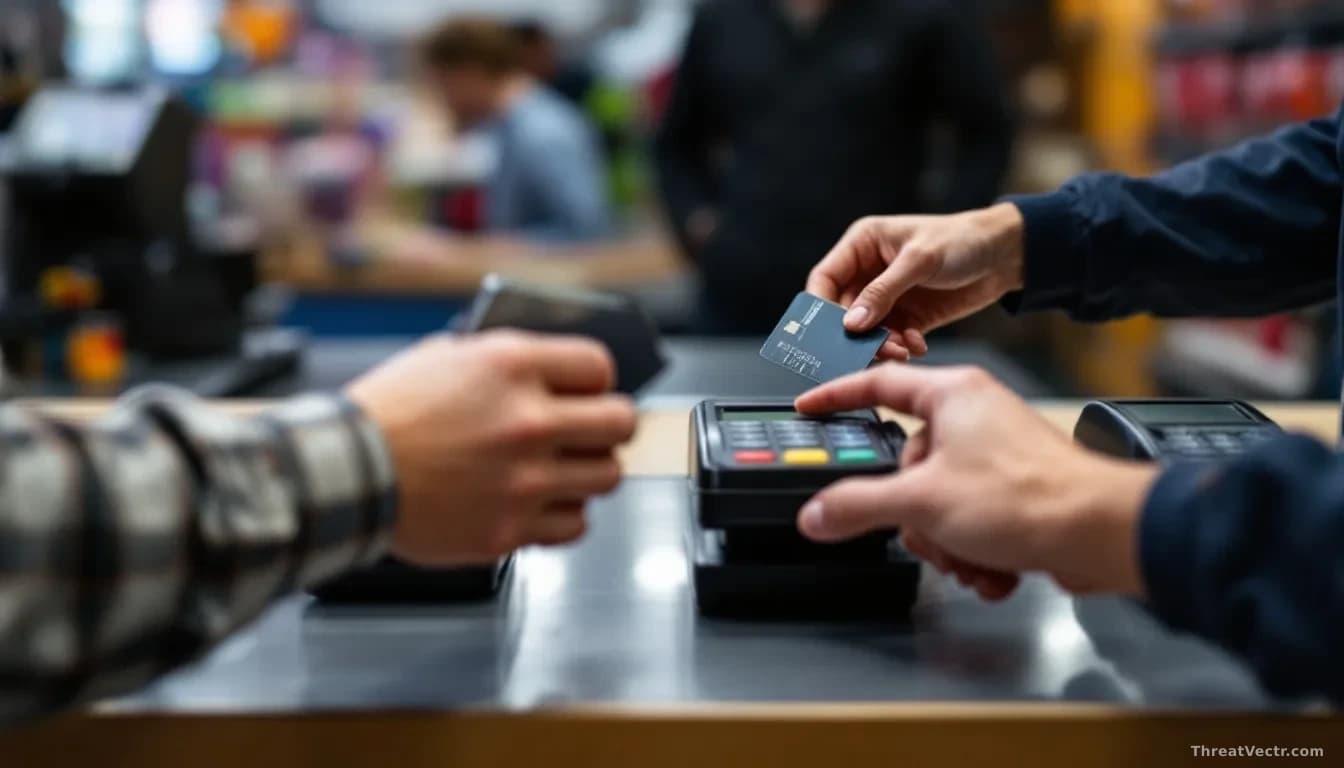
Use tap-and-pay whenever a terminal offers it. Tapping uses a one-time digital code that is useless to anyone who intercepts it. Agent Peck called it "the best way to protect yourself as a consumer."
If you must swipe, give the card slot a firm tug first. A skimmer often wobbles or pops off. Cover the keypad when entering a PIN.
If you use a government benefit card, check your balance frequently. Report any unexplained drop to your benefits agency immediately: timing matters, and the sooner a theft is reported, the slightly better the chance of action. Physical card fraud is getting harder to outrun, which is what makes the push toward chip and tap payments so consequential for people who don't have the choice to switch.
Common questions
Should you worry about skimmers at small-town ATMs?
Yes. Agent Peck noted that while major cities such as Los Angeles see the highest concentration, skimmers turn up in small towns too. Any unattended terminal is a potential target.